
The mechanism: arteries get stiffer
A healthy artery is elastic. When the heart pushes blood into it, the vessel expands to absorb the surge, then recoils and keeps the blood moving between beats. That elasticity is what stops each heartbeat arriving downstream as a hammer blow.
With age, the elastin in the artery wall frays and is gradually replaced by stiffer collagen. Calcium deposits accumulate. The vessel loses its give. When a stiff artery cannot expand to absorb the surge, the peak pressure of each beat rises — which is why systolic pressure, the top number, tends to climb with age while the bottom number often flattens or falls. That widening gap is one of the more reliable signatures of arterial stiffening.
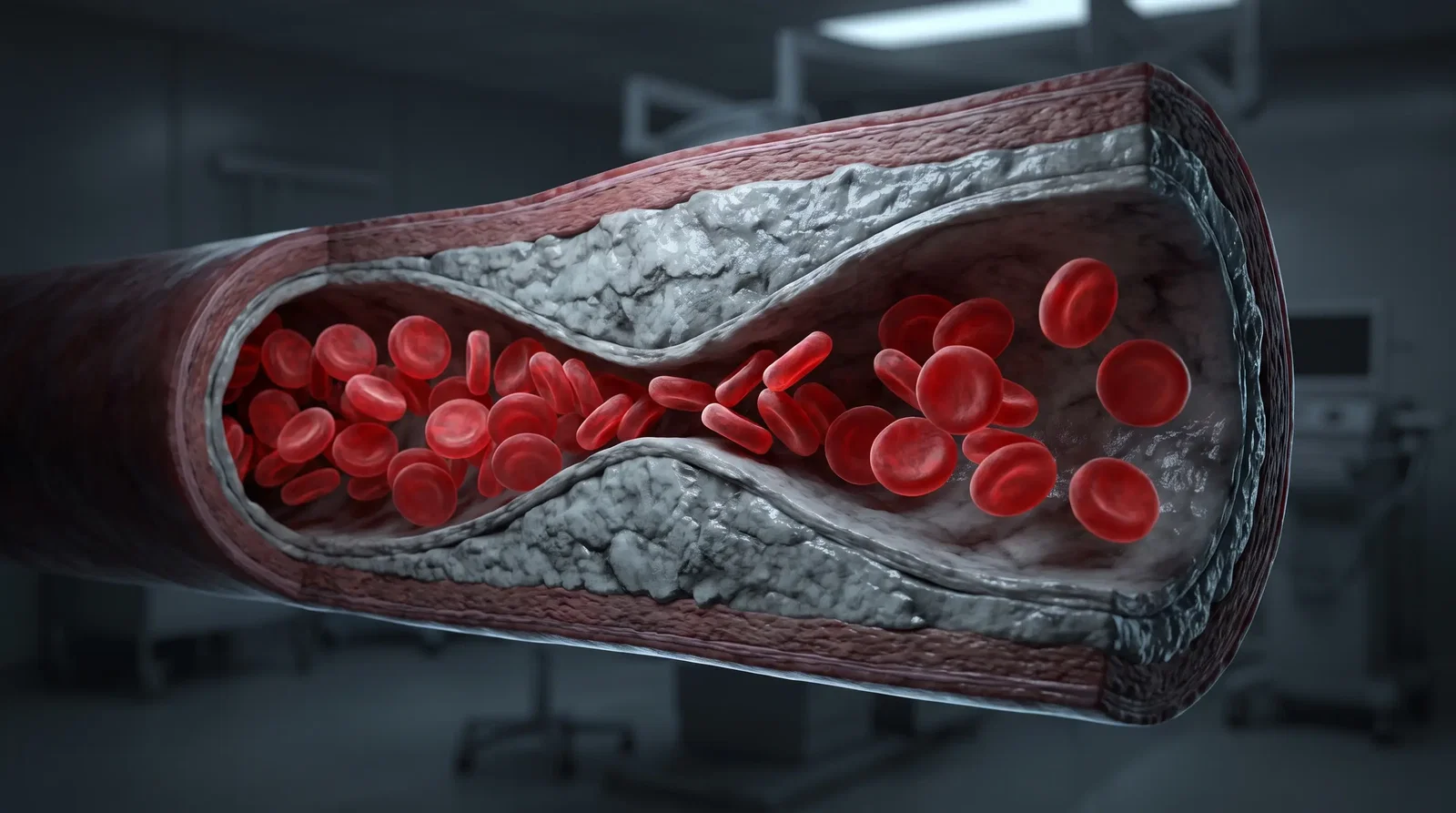
This is the grain of truth inside a lot of overheated marketing. It is genuinely true that stiffening drives the age-related rise in systolic pressure, and genuinely true that a pill lowers pressure without reversing the stiffening underneath. What does not follow — and what gets sold hard — is that the medication is therefore pointless, or that some inexpensive ritual dissolves what has hardened.
Lowering blood pressure is not cosmetic. Large randomised trials show it prevents strokes, heart attacks and deaths — whether or not the artery underneath ever becomes elastic again.
The plastics finding, stated accurately
You may have seen a claim that plastic has been found in human arteries, attached to a startling risk figure. The underlying study is real, and it is worth reading properly rather than through a headline.
of carotid plaques removed from 257 surgical patients contained detectable polyethylene. Over a median 34 months of follow-up, those patients had a higher rate of heart attack, stroke or death from any cause than patients whose plaques showed none.
Marfella R. et al., New England Journal of Medicine, 2024That is a striking result and a legitimate line of research. It is also, precisely, an observational association in one group of patients already sick enough to need carotid surgery. It does not establish that plastic particles cause cardiovascular events; people with plastics in their plaque may differ in other ways that also raise risk. It has not been replicated at scale. And nothing in it points toward any supplement, food or ritual as a remedy — the paper proposes no treatment at all.
Where the popular version parts company with the research
Plastic particles were detected in most excised plaques, and their presence was associated with a higher event rate in this surgical cohort.
That plastics are proven to cause heart attacks, that this explains most hypertension, or that any product removes them.
Arteries stiffen with age, and stiffening raises systolic pressure. Antihypertensive drugs reduce strokes and heart attacks.
“Arterial cement” as a named condition, claims that a ritual dissolves calcified plaque, and any suggestion that pills are a placebo.
Sardinia, and what its longevity research actually found
Sardinia is not a marketing invention. A mountainous inland area of the island — the Nuoro province — was identified in the AKEA study as having an exceptional concentration of male centenarians, and it is one of the regions later popularised as a “Blue Zone”.

What researchers describe there is a pattern, not a pill: a largely plant-based diet with beans and whole grains, moderate dairy from pastured sheep, modest meat, sustained daily physical activity from shepherding hill country, strong family and social ties, and low chronic stress. Attempts to isolate one compound from that and sell it are exactly where the honest research ends and the copy begins.
What actually lowers blood pressure
This is the part with real trial evidence behind it, and it is unglamorous enough that nobody builds a video around it.
The DASH dietary pattern
Rich in fruit, vegetables, whole grains and low-fat dairy, low in saturated fat. In the original randomised trial it lowered systolic pressure meaningfully within weeks, and more so in people who were hypertensive at baseline.
Less sodium
Combining DASH with reduced sodium produced a larger fall than either alone in the DASH-Sodium trial, with the biggest effect at the lowest sodium level tested.
Regular aerobic activity
Consistent moderate exercise lowers resting pressure and is one of the few things shown to improve measures of arterial stiffness rather than just the reading.
Weight loss where there is weight to lose
Reduction in body weight tracks reliably with reduction in blood pressure, and the effect is dose-dependent.
Less alcohol, and treated sleep apnoea
Both are common, both are under-recognised contributors, and both are addressable. Untreated sleep apnoea is a frequent reason pressure stays stubborn despite medication.
None of that is exciting, and all of it is better supported than anything you will be sold. It also works alongside medication rather than instead of it — which is the arrangement most people with hypertension end up in, and there is no shame in it.

If your numbers are not settling
Stubborn readings despite treatment are common and worth investigating properly rather than working around. The usual suspects are a home monitor that has never been validated against a cuff at the surgery, an incorrect cuff size, readings taken straight after coffee or walking in, undiagnosed sleep apnoea, alcohol, NSAIDs and decongestants, and occasionally a secondary cause that needs specific testing. That list is a conversation to have at your next appointment.